Posts

Showing posts with the label ssb

I tried asking google's bard AI: Why do ham radio opzerators use lower sideband below 10 MHz and upper sideband above 10 MHz ?

Image
here is bard's answer in text: There are a few reasons why ham radio operators use lower sideband (LSB) below 10 MHz and upper sideband (USB) above 10 MHz. * **Historical reasons:** Early amateur SSB rigs used a 9 MHz intermediate frequency (IF), and it was easier and cheaper to generate LSB below 9 MHz and USB above 9 MHz. This convention has carried on even though modern rigs can generate either sideband equally well. * **Propagation reasons:** The ionosphere, which reflects radio waves back to Earth, is more effective at reflecting LSB signals below 10 MHz than USB signals above 10 MHz. This is because the ionosphere is more dense at lower frequencies. As a result, LSB signals are more likely to be received over long distances on the lower bands than USB signals. * **Interference reasons:** There is less interference from commercial and amateur radio stations on the lower sidebands than on the upper sidebands. This is because the lower sidebands are used less frequently. As a re...

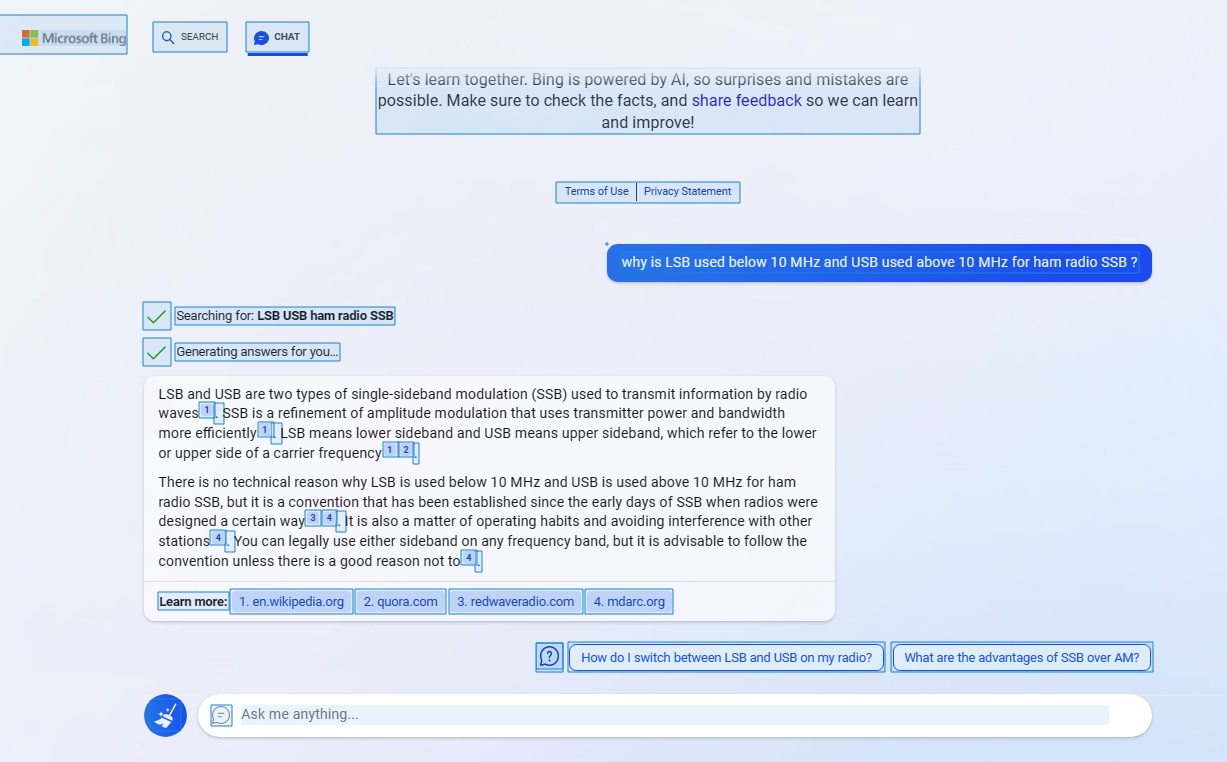
Bing AI still doesn't know

Image
The Q and A: Even if it was technically correct this answer doesn't make sense to me.  If it was harder to generate USB signals then why even try ?  Why not just designate all SSB work to default to LSB ? The blame isn't with the AI, it's relying on a website to craft answers.  I guess what they really ought to develop is Artificial Common Sense. Best Regards, Chuck, WB9KZY http://wb9kzy.com/ham.htm

Why USB versus LSB on 20 meters and above ?, let's ask the AI

Image
 I tried using the Bing search engine AI to ask about why the low bands use LSB and the high bands use USB. The answer references two pages for technical reasons why: http://www.redwaveradio.com/11_4d1c8dd3748ce22d_1.htm "The ham radio practice came about because of a particular military surplus radio that when added to a carrier generator produced USB over 10 mHz and when subtracted LSB below it." https://www.mdarc.org/operating-aids/lsb-or-usb "It's a historical oddity. Early amateur SSB rigs used a 9 MHz IF system, and it was easier and cheaper to generate LSB below 9 MHz and USB above 9 MHz. You will notice that on 160, 80 and 40 meters, LSB is mostly used and on the higher frequency bands, USB is used. This is a leftover from the early days of SSB when radios were designed a certain way, when SSB was in its infancy." So basically AI doesn't know the reason either :) The first reference seems plausible but no details - this wasn't documented in QST t...

Book Report: Wes Schum: Amateur Radio's Unsung Hero

Image
This is a very interesting biography of Wes Schum, the driving force behind Central Electronics.  Central Electronics was a Chicago based firm started by Wes to sell a modified version of the GE Phasing SSB rig developed by Donald Norgaard.   An amusing anecdote tweaking Art Collins:  Art wanted a 10a exciter but Wes didn't have any wired 10a transmitters in stock so he asked Art if there was anyone there (at Collins Radio) who could assemble a 10a kit.     also: the Collins people didn't read the fine manual, after wiring the 10a to the schematic they tried a 14.250 MHz crystal and the transmitter wouldn't work.  Wes had to tell them that the 10a used crystals in the 5 MHz range for 20 (mixed with the 9 MHz IF). The 100V transmitter was no-tune, a first for ham gear.  The no-tune circuit was developed by an engineer named Joe Batchelor from Georgia who eventually became an employee of Central Electronics.  Unfortunately Central Electronics w...